Showing posts with label food. Show all posts

Monday, May 12, 2008

Derby Deviled Eggs

Spring comes late and unpredictably in our part of the world. One sign of spring for sure is the annual Running of the Roses in Kentucky. No matter how cold, wet and rainy it is here in western Massachusetts, The Kentucky Derby happens every year, never fail, on the first Saturday in May. Ever since I was a little girl, I’ve been going to Derby parties, first with my parents and sisters, and then throwing a party or two of my own. I love the tradition of the Derby – the hats, the flowers, the magnificent old grandstands at Churchill Downs, the beautiful silks on the horses and the jockeys and the singing of My Old Kentucky Home.

When we moved here, I needed to find someone else who might be keen to celebrate this rite of spring. Lucky for us, my friend Kay who also grew up in NJ had grown up in a home where her mother threw a fabulous Derby party. We’ve been celebrating the Derby with Kay and her husband Mike for many years now. We do low-tech, low-stakes wagering and winner takes all.

Mostly it is about the food and the mint juleps that afternoon. Kay is an amazing chef and we always look forward to what she prepares. Every year she asks me bring my deviled eggs. I’m not the most fabulous cook but I try. Evidently I make a mean deviled egg because they are instantly gobbled up. There’s something so sinful about these little boats of flavor.

Kay has been clamoring for my special recipe for Derby Deviled Eggs. This past weekend, I was having a dinner party in honor of The Farmer’s birthday. I made up another batch of Derby Deviled Eggs to test out all my proportions. (That’s one reason I don’t post recipes here on my blog – too much trouble with testing and re-testing recipes). Here it is for Kay and for you:


Perfect Boiled Eggs

Here’s how to make perfect hard boiled eggs every time. I learned this trick from my Aunt Marilyn. Put a dozen extra large eggs in a large pot. Fill it with cold water. Put it on the stove and bring it to a boil for a minute. Turn it off and let the eggs cool in the water. When the water is completely cool, peel the eggs. You’ll have perfectly cooked eggs, without that nasty green edge that sometimes happens when you overcook hard boiled eggs.

Derby Deviled Eggs

1 dozen extra large eggs
1 Tablespoon Dijon mustard
3 Tablespoons sweet relish
3 Tablespoons mayonaise
3 Tablespoon capers packed in vinegar and drained
Several dashes of Tabasco sauce, depending on how devilish you want your eggs
Good handful of fresh chives
Paprika

Egg Note: Fresh eggs from my chickens always cause peeling problems. They're just too fresh to peel. Chicken farmer that I am, I always purchase my eggs for deviling at the store because they peel easily.

To Devil the Eggs:
1. Peel the eggs. Cut in half and put all the yolks in a medium sized bowl.
2. Mash the yolks but not too much – I like them a little chunky but, of course, this is a matter of personal preference.
3. To the mashed yolks, add mustard, sweet relish, mayonnaise and capers. Mix through.
4. Using a spoon, fill all the egg boats with a generous scoop of filling. I usually will have a few white boats left over which the dogs gladly accept as a snack.

Snip the chives into ¼” pieces leaving 24 of the tips about 3” long. Place the eggs on your serving platter. Spear each egg with a chive tip. Sprinkle the rest of the chives all over your eggs and plate as decoration. Watch them disappear!

Saturday, April 12, 2008

Blueberries Someday

Have you ever eaten low bush blueberries? They're very tiny and sweet and grow in the wild, mostly in Maine. There are some fields of native blueberries in Massachusetts - mostly on the tops of mountains that are rocky. One happens to be in the town we live in. Although the blueberries are native, it takes some farming to keep the fields bearing.

Yesterday, this was the biggest news in our little town - the blueberry fields were burning. It was very exciting because they haven't been burned in almost a decade and haven't been harvested in quite a while.

This is how it happens. They get a burning permit and pick a day when there is no wind. It helps if the ground is still wet which it was yesterday. They light a brush fire and the field slowly starts burning.


There are lots of rakes and just in case large tanks of water.


The fire slowly spreads. The leaves and the stalks of the berry plants burn. The goal is to only burn the plants. If the fire spreads to the roots, it takes longer for the plants to recover. When it is done, the field looks charred.


The plants won't start bearing until 2009. We all are looking forward to lots of fresh sweet berries soon.

Tuesday, April 01, 2008

Saps a Running

It is April 1st here and everywhere. We’ve had one of the coldest, snowiest winters since we have lived on this farm. Yesterday it snowed, yet again. Everyone around here, including the chickens, sheep, dogs, and cats, are waiting for spring to come and the snow to melt. Waiting and wondering if it will ever arrive. We know it will someday. The spring birds are returning and I am sure they are perplexed by the frequent appearance of more and more snow.

One of the most noticeable rites of spring in these parts is the appearance of galvanized buckets hanging on little hooks from the sides of maple trees. Each spring, farmers drill fresh holes in their maples, hang their buckets, and wait for the sap to flow. Talk around here is about “how the sap is running.” Depending on which farmer you talk to, you will get all kinds of conflicting stories. These buckets are incredibly beautiful weathered by years of wear and tear.


We have been enjoying the sites, sounds, smells, and flavors of our neighbors collecting and boiling this sugaring season. Sunday we walked our road to check on the progress of the harvest.


If you were here, this is what you would see:

Just beginning to drip....


Almost....


The saps drips and pings as it hits the bottom of the bucket.


Lot of the maple sap is now being collected via a pipeline system that gravity feeds into large 250 gallon collection tanks. It’s not nearly as picturesque as the bucket system but as with everything, efficiency counts. In the old days, large families would spend their days collecting and boiling but as the population left the farms and families aren’t as large anymore, pipeline collection systems are easier. Thank goodness our neighbors still hang some buckets.

The sap flows best during the day when the night before was below freezing and the day is well above freezing. The past few years, the sap season was late February and early March but this year it’s much later. From what we hear, it seems like it is going to be an extra long season with lots of syrup being produced. Here's some sap boiling at our neighbor's sugarhouse.


Oh how I love living in New England.

Wednesday, February 13, 2008

February Winter Goes On and On

More snow, sleet, and freezing rain here. If it were colder and all snow, we would have had a heck of a blizzard. It's the kind of day you just want to stay inside all day - which is what Julia and I did with the exception of feeding the chickens and trying to lure in the elusive guinea fowl which just don't want to be back in the coop. I have a feeling there may be some kind of bird territorial issue going on and these three have decided it's easier to stay outside.

Thanks for all the comments and interest in the "lard project." This weekend, I did a pizza rustica recipe from Nigella's How to Be a Domestic Goddess book. It's similar to this one here on her website. I've never been very good at rolling out pie dough and Sunday was the same. The thing was a mess - broken pieces everywhere. So I just patched it up and placed it in the springform pan. I used half lard, half butter. The top looked like a nightmare when it went in. I sloshed some eggy-watery mixture on top and in about an hour, the disaster transformed itself into a beautiful golden pie. I swear it was the lard. It was an amazingly flaky and light pie crust.


But boy, was it rich. Luckily, we had picked up some blood oranges and grapefruit for fresh squeezed juice. The tartness of the citrus set off the richness of the pie. And you can't beat the color for the winter doldrums.


I've got so much of the lard though that I'm trying to give it away to local friends. So far, I've only found one friend, Maggie who is a chef at our favorite local restaurant Hope and Olive, who is interested. I'll deliver her a pint and I'm sure she'll do something magical with it. I think everyone else thinks they will gain 10 pounds just by looking at it and having it in their refrigerators. If all else fails, I know my chickens will love it mixed with their daily rations.


The other day, I told you how I fed the chickens the leftover bits from the lard making project. It's basically pure fat and with the winter they have been through, I knew they could use some. I hadn't gotten an egg since early December and darn it if I got three the next day. Must have been just what they needed, along with the longer days, to get them going. It was killing me to have to buy eggs at the grocery store. They're back in production mode.

I'm off to Minnesota in the morning. I hope to meet some of you there either Friday night at the Textile Center or at the Mall of America over the weekend. Here's a priceless picture of Julia on our walk the other day just as a snow squall was beginning to fall quickly around us.

Wednesday, February 06, 2008

Backfat or Not?

Maybe some of you remember that I raise pigs every year. I get the piglets in the early summer and we take them to harvest (or slaughter) in very early winter. This year I raised three pigs and I have been trying in earnest to cook all the different cuts of meat so they tasted exceptional – thereby doing justice to the animals i raised.

This is much easier said than done. I’m a self-taught cook and not a chef by any means. Every year, I ask for cookbooks for Christmas. My go-to books this winter are Bruce Aidells' Complete Book of Pork and Michael Ruhlman and Brian Polcyn's Charcuterie: The Craft of Smoking, Salting, and Curing. We’ve also been reading mainstream books about raising food -- including Michael Pollan’s The Omnivore’s Dilemma and Barbara Kingsolver’s Animal, Vegetable, Miracle. The Farmer and I know we are living a life these two authors probably would love to live – raising our own meat in a good and respectful way. Perhaps you too have read these books – they were both on the bestseller’s lists for months.

Taking care of the animals, once they are slaughtered and in the freezer, is different from feeding and caring for them daily. It starts out with the order at the slaughterhouse. The butcher asks me lots of questions which I just hope I answer correctly. Not that there is a right or wrong answer. My answers though will determine how I cook the meat and fit it into our daily schedule. It’s different than going to the grocery store and picking up a pork loin.

The butcher, with his New Hampshire Yankee accent, asks me questions: Chops – how thick? Loins – how many ribs? Shoulders – fresh or smoked?; Do you want your hocks smoked or fresh?; Hams – fresh or smoked? Hams – sliced, whole, or half? Bacon (or belly fat) smoked or fresh? Do you want the feet?

Over the past few years, I have figured out how to answer him by trial and error. I’m slowly figuring out how to cook different cuts to make them taste the best they can. There are lots of parts of a pig, once slaughtered, that most American people never deal with (the French on the other hand have a use for everything!). I am taking it as a challenge and learning as I go – similar to experimenting with a new knitting technique such as fair isle or lace or cables. It’s a fun way to spend a cold winter season – reading, planning and cooking.

Every year, the butcher asks me “Do you want the fat back?” I, of course, with my waste not - want not philosophy, have always aswered “yes.” I am inheretly frugal. Although not a Yankee by birth, I seem to be picking up lots of my adopted New England's traits. When Julia and I pick up the pigs (or pork as we now refer to them), there are enormous slabs of fat attached to the skin of the pig plopped atop of the banana boxes loaded with perfectly wrapped loins, shoulders, and ribs. The hair has been shaved from the skin – but they look like they should – the skin from the animals I have been feeding for five or six months.

When I get home from the slaughterhouse, I stuff all it in the freezer. Slowly, I work my way through the pile of meat over a few months, moving aside the backfat each time I have to dig for the perfect roast. The past few years, after months of moving the backfat around, I have given up and fed it to the chickens.

I’m proud to say that this year, this didn’t happen. For the past few weekends, I have been working on my “lard project.” When I began, The Farmer was not at all startled. In fact he was encouraging. He told me that there was always a large square box of lard in his refrigerator when he was growing up. His mother did make the most amazing pies and evidently her secret ingredient was lard.

I have persevered. It started out slow. For my first batch, I followed the instructions found in Bruce Aidells' Complete Book of Pork and cut the fat up into tiny 1/2" inch squares. It wasn’t easy – I had to use surgical scissors to hack through the skin. Then I baked it at 350 degrees until it smelled done and there was lots of liquid in the bottom of the 8” sided pot I used. The tall pot is essential - so that the fat doesn’t burn and catch fire in the oven. But honestly, that cutting into small pieces was a nightmare. It took so long, I cursed my way through it. The fat cooked slowly and started to smell a bit like roast pork. When it was done after a few hours, there was a large amount of clear liquid in the bottom of the pot and lots of mighty crunchy bits of pigskin or "cracklings" floating around. We shared them with my chickens after tasting a few.

This weekend, with the advice of my friend Kay who owns a bakery and is a chef, I cut the backfat into pieces about 4 to 5” square. This was a huge timesaver. When the fat was rendered (that is the proper term), I strained the liquid through a fine sieve into some canning jars and stashed them in the fridge wondering what I was going to do with all of it.

I made some oat biscuits substituting the lard for butter weight for weight and they were really flaky and tasty. I’m not much of a pie baker but I think I’ll try some crusts for chicken and meat pot pies this winter.

Do you have lard-y memories of earlier days? What were the favorite recipes your grandma cooked with lard? I’ve got a bunch of it and I’ve got to cook my way through it somehow! Any help will be greatly appreciated.


Here are some good lardy links to read if you are interested.
From Food and Wine: Lard - The New Health Food
From The Seattle Times: The Real Thing

Monday, December 17, 2007

It must be December

More wild winter weather here in western Massachusetts. I can’t say I mind it – everything looks beautiful - like a picture postcard. The snow isn’t stopping. We thought something was up this November when Cookie and Ginger, two of our cats, grew incredibly fluffy, long coats. The Farmer and I talked about it, saying we must be in for a rough winter and so it is. Compared to 2007 when it was 60 degrees in late December, I will take this anyday.


Farming continues, no matter the weather. Animals need to be fed and cared for. But Friday was the day I have been dreading. It was the day the appointment was made for my three, now big, pigs. I have raised pigs for four years and know that with the arrival of each new set of piglets, they will then leave about five months later as much larger animals. They live very happy, if short lives rooting around in the earth and eating well. This year’s pigs even began as pasture raised pigs and grazed with the sheep for about a month until they began doing lots of damage to the pastures with their snouts.


The past month or so has been an adventure for them. They have been busting out of their confines and visiting the neighbors up and down the road. They have been exploring the apple orchard, grazing on fallen fruit. Luckily our neighbors are rather patient. Todd and Jess down then road call them the Visiting Ladies Auxillary – three pigs digging around their yard in the frozen earth not finding much. Alicia's pumpkins were mighty tasty.


But then winter hit. They haven't wanted to venture too far. This past week has been mightly dicey walking out on the ice with a large bucket of grain and a large pail of hot water, trying not to fall on my butt while hiking out to feed them. We had a foot of snow Thursday which was going to make moving the livestock trailer difficult to say the least. Luckily, some of our neighbors are also farmers and they came down with a plow and helped The Farmer load the pigs. It went smooth as silk and we got them to the slaughterhouse in New Hampshire and were back in time to pick Julia up from school.

I always feel very sad the first few days my pigs are gone. I'm so used to hearing them snorting and cavorting in their pen everytime I come out of the house. I will miss them and the daily task of talking to them each morning and feeding them. But my chickens are still here and I should be getting some eggs soon as the days become longer. Tonight Julia and I will pick up the pigs and they will feed us and several others for the year to come. In a few weeks the hams and the bacon will be done too.

If you are interested in learning more about raising pigs, here are a few good websites: Sugar Mountain Farm in Vermont, British author Hugh Fearnley-Whittenstall's River Cottage, and Jimmy Doherty's Essex Pig Company.

Tuesday, October 09, 2007

Leaf Peeping?

Today is the 8th of October and by the history that I’ve got hidden somewhere in my little brain, this past weekend (the weekend after my birthday) should be peak foliage here in our corner of the world. But instead, it has been in the 70’s and 80’s with no rain for a very long time. Lots of the oak trees have dropped their leaves.

Instead of the red and orange and gold of the maples we usually experience on this past weekend, we still have zinnias blooming and blooming - oh how I love their exuberance.
I'll take the extra blooms in my vases and kitchen while I can.


I really do look forward to leaf-peeping season every year. It is my very favorite time of year – I break out all the woolens and go for long walks in the crisp, newly cold air. Instead, we have…… Beautiful red dahlia’s blooming .....


And my tomatoes are still ripening. It seems I planted very few red tomatoes this year and the sauce I am putting away is more orange than red. Oh, the trouble with heirlooms tomatoes, nary a red tomato!


The sunflowers on the other hand, have finished their show and the birds are enjoying the fruits of their labors. We've put out some beautiful large pumpkins onto the self-serve haywagon and we're hoping they get purchased before they get squashed!

I never get to making pesto until frost is threatened. Since that hasn’t happened yet, my basil is still growing and blooming. But tomorrow I am going to get to that basil and mix up several batches of pesto to put away for the winter. Black fingernails without polish for sure.

Tuesday, July 24, 2007

Intergenerational and Cross-cultural Knitting

One of the most amazing things about knitting is the reach it has through many generations and across cultures. Before Julia was born, The Farmer and I used to take a nice trip once a year (I racked up a lot of frequent flyer miles which surely did help). We traveled to France a few times, exploring the back roads and enjoying the food and wine. We visited Scotland, England and Wales - sheep peeping and wool watching, meeting local farmers at the many independent pubs in the towns we stayed in. In Portugal, we snuck into every church we could find – they were filled with art and craft and amazing ceramic tiles from the hey day of the Portuguese explorers. The fabulous seafood, the site of the little gardens behind every home poked onto steep hillsides, the wines and vineyards – these memories still flash through my mind from time to time. I'm still lusting after the amazingly tall kale plants which seemed to be in every garden. I can still taste the caldo verde soup I ate day after day made from this amazing plant. Portugal is the reason I love low care geraniums so much.


One of the fondest memories I have of our traveling days is an afternoon stop at a little café somewhere deep in the Portuguese countryside. We found a quaint little bar in the center of the town and stopped in for an afternoon espresso. The café was full of local working men in their blue jumpsuits, all downing a quick drink before heading home to their families. We were always an oddity in these places – the towns we traveled to didn’t see many Americans.

Never one to a woman without her knitting, I pulled out a pair of multi-colored gloves I was working on. I sat there knitting at a little table while The Farmer order his espresso and my cappucino. I saw a woman across the room staring at my hands knitting. She had her grandchildren in tow. I could tell she was fascinated watching the pattern build up from the different colors of yarn I was knitting with. Round and round I went on my double pointed needles as she kept watching. I caught her eye and smiled at her. She drew up her nerve and came and sat next to me. She couldn’t speak English and I could only say “Obrigado” (thank you) in Portuguese.

The Farmer came back to the little table to find us deep in conversation – knitting conversation that is. She was speaking in Portuguese – telling me Portuguese knitting terms and asking me questions. I was explaining in English what I was doing and the plans I had for the gloves. The Farmer gave me my drink and promptly went back to the bar to sip his. He knew there was no hope. The woman and I continued to chat about knitting. It was a curious conversation – neither of us knew what the other was saying but through the language of knitting we learned about each other. I didn’t want the conversation to end.

I’ll never forget that afternoon – probably not for the rest of my life. It’s amazing how knitting can bring people together – odd combinations of people. Without knitting, they wouldn’t give each other the time of day. Throw in a little knitting at a café or wear a handknit hat and scarf and watch the conversation start.


I’ve made many friends throughout my knitting career. Many of these friends I have initially met because they have knit projects that I have designed. We meet through the knitting but then we become friends. I learn about their families, their jobs, their bosses, and their pets. They are women of all ages from throughout the USA. Most of them knit because they love to – they like the challenge of a new project. They like to take some rough directions, some charts, and some little sketches and turn the yarn I give them into what I want. I think about all of them as I am designing a project and knitting a swatch. I think about who would like to do what. I wonder how they are doing. I catch up with them when I send them a project. They call and ask questions and I find out what’s going on in their personal life. I love this connection – of many years and many projects.

It’s a similar thing with the blogosphere – I began my blog as a marketing tool but it has become something else. By reading other people’s blogs, I see how other knitters live and stitch. I learn about their families, their trials and tribulations. It’s an odd thing, this knitting blog thing – but it’s a good thing. I see what other knitbloggers are knitting without leaving the comfort of my home. It still blows my mind!

I’ve had my blog now for well over a year and I thank all of you who read and comment. I like to think my blog has become a small part of one giant knitting circle with a little farming and life thrown in – similar to the quilting bees of old. How lucky we all are to have this new medium to continue to pass on the stitching love and lore.

Wednesday, May 09, 2007

Eggs Aplenty

At this time of year, I am always looking for ways to use our hens’ eggs. In the spring, they lay with wild abandon. I deliver them to friend’s houses, leaving them without a note on their front porch, hoping they will find them and won’t step on them. And then I rack my brain for ways we can eat them – fried for breakfast, in an egg salad sandwich (I add sweet relish and capers and it is wonderful), deviled for an old fashioned appetizer, and in a frittata for dinner.

One of my favorite uses for eggs is to make an afternoon batch of popovers. A few years ago I invested in a popover pan and it makes the most beautiful specimens that easily pop out of the pan. I also don't have to fool around with small ramekins or the every other placement in a muffin pan. I like Julia Child’s recipe for popovers from Baking with Julia. It differs from this recipe – it has one extra egg and two tablespoons of melted butter. She suggests whirring it all in a blender and sifting out the lumpy flour. It takes about 3 minutes to make. The hard part is the waiting and not being able to open the oven while they bake.


And then, after the required 45 minutes in the oven, I open it, and there is this sheer magical little thing. It's amazing what a little flour, eggs, butter, and milk can become. I crack it open and the steam escapes. The center is filled with a semi-gooey, eggy goodness. With a little jam and some tea or coffee, it transports me to another place - much slower and saner than the modern world.


There is a local restaurant in Amherst called Judie's which is well known for its eclectic menu featuring popovers. It's worth a visit if you come this way.

Wednesday, April 11, 2007

Hot Stuff

A few days ago, I wrote about the maple sap that was being collected on our dirt road and throughout New England, New York and Canada. Here in western Massachusetts, the sap season is about over. Usually, the season ends when the trees start to bud but so far this year, it hasn't been warm enough to make that happen. I'm not sure why, and maybe someone out there can tell us all, why the sap has slowed down but it has.

When Mom was here this weekend, we took her to Williams' Sugar House in South Deerfield. Our neighbors sell their sap to the Williams Family - I thought we should be authentic and watch it be professionally boiled. Besides being a right of spring, sugaring is just plain fascinating. It takes 40 gallons of sap to make 1 gallon of syrup. It's an exacting, pain-staking process for someone with lots of patience. Throughout New England, big and little sugarhouses abound. Guys (mostly) hang out near the evaporators for hours, feeding the fire with wood and watching the sap boil. There's a fine point between finished and burnt - I know because I've burned a batch or two much to The Farmer's utter dismay. You can learn more about maple syrup and sugaring here.

This is the "evaporator" at William's. The wood goes in down below. The smoke goes out the long pipe on the right and the steam from the sap exits the short pipe. At the front of the evaporator, the sap is finished.


Lots of old-fashioned sugar houses also offer old-fashioned breakfasts with pancakes, waffles, and sugar-on-snow. The sugar houses are only open during sugar season. It's worth planning a trip to experience the entire tradition.


Real maple syrup is unbelievably sweet and flavorful. Make sure you have experienced it at least once in your life. We don't eat much of it around here because of Julia's diabetes. I tend to use it in cooking as a marinade. I slathered our Easter ham with a mix of maple syrup and mustard and it was delicious.

Here's a recipe for a mud rub that I use in the summer on pork on the grill. It's also good on chicken.

Kristin's Maple Spice Mud Rub

5 cloves garlic mashed with a little olive oil
1/4 cup maple syrup
1/4 cup paprika
1 tablespoon ground cumin
1 tablespoon cinnamon
2 teaspoons ground coriander
1 teaspoon salt
1 teaspoon freshly ground pepper

Mix all ingredients in a bowl. I like this best on pork or chicken. Before grilling outside, rub the mud all over the meat and then grill as usual.

Friday, March 09, 2007

Lamb Update

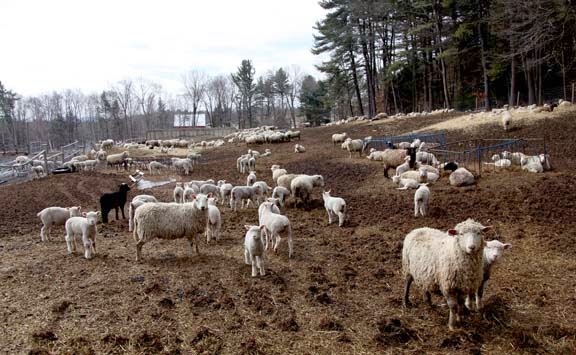
It's still unbelievably cold here. The snow has got a thick coat of ice on it and it makes walking difficult for humans, much less sheep and lambs. They have managed to forge a couple of paths through the ice but most of them are just staying in the barn or just outside it where the enormous bales of hay are.


The lambs are growing - some more than others. The single lambs always grow the quickest because their mom's are only feeding one baby and they make the same amount of milk. The twins usually are smaller and so the grain helps them gain some size. The Farmer is talking about trying to separate the sets of twins and singles (and their moms) next year so he can better address this problem. I'm not sure how he plans to do that since there is only one barn and maybe it is best I don't ask.

Lambs love to be in high places. Frequently there will be 4 or 5 lambs on top of a large bale of hay munching away. Then they literally fly off the bale, run around, and climb back up again. I've been trying to get a photo of this but so far, no luck.


When The Farmer feeds out a bale of hay, it is a big event. Everyone gathers around and munches away. It gets pretty dicey, this feeding thing. The bales weigh more than 800 lbs. He picks them up with a long spike that is on his tractor, transports it to the feeder and then drops it. It's best if there is someone there to help out because the sheep get so anxious to eat that there is a real danger for them - especially the lambs. In this photo, his brother David, The Dairy Farmer, is helping to shoo away the sheep while the bale is dropping and Jeremy is looking on.


The lambs are genuinely eating the hay now - not just picking at it to see what it is. This little guy was so desperate for some hay that he was walking all over the backs of the mom's. He was trying his hardest to jump in the feeder to eat but couldn't quite make it. The adult sheep crowd out the lambs because they are so hungry. The lambs end up eating after their moms are through. There is always enough food left for everyone. I guess sheep are a little different than humans. It seems I always feed my family first and then get my own food after everyone is settled. But then, the ewes are feeding their lambs all day long so I guess it is no different.

Right now I am reading a fabulous book by Michael Pollan called The Omnivore's Dilemna: A Natural History of Four Meals. I love his writing - he makes what could be a very dry subject interesting. I'm about half way through it. If you have any interest in your food, how it is produced, and how the agriculture industry - both organic and regular - has evolved, I highly suggest it.

Easter is coming up on April 8th this year. Many of the lambs that we are growing will be going to an auction where they will be sold to processors and become Easter dinner. After reading The Omnivore's Dilemma, it makes me realize what a good quality product The Farmer is producing. At this time, we sell the lambs into the normal chain of supply and really don't get as much money for them as we should. But for right now, it's the best way to keep farming and fitting the sheep operation in with the other parts of our life. I keep toying with the idea of going to a local farmer's market and selling the lamb direct to the end-user but I just haven't gotten my act together. Maybe when Julia gets a little older? Something to think about.